Work
Things I've built, broken, and occasionally shipped. Roughly in order of how much they currently keep me up at night.
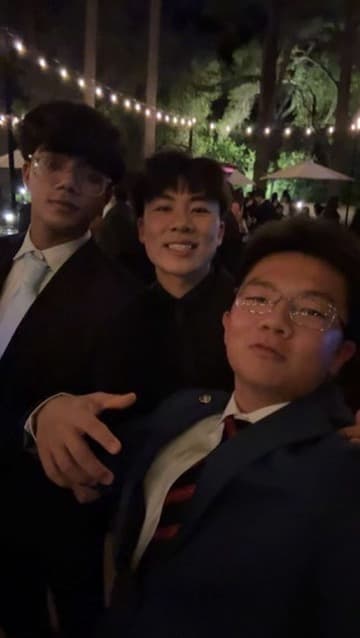
Kairos
Co-founder. April 2026 to present.
Kairos started as a marketing agency running short-form campaigns for startups in the Bay. Along the way we realized we were leaking valuable demographic and retention data with every campaign we shipped, so we started collecting it. That dataset is now the foundation of the company.
We use that data to build agent swarms that simulate marketing campaigns before they're even rolled out. We still have our predictive engine (GBT) and our RAG-based feedback model, but those are secondary features now. The simulation layer is the core product.
Seven completed campaigns, 1,300+ videos produced, 30M+ views, and over 50 creators in our network. If you'd like to help out, feel free to reach out.
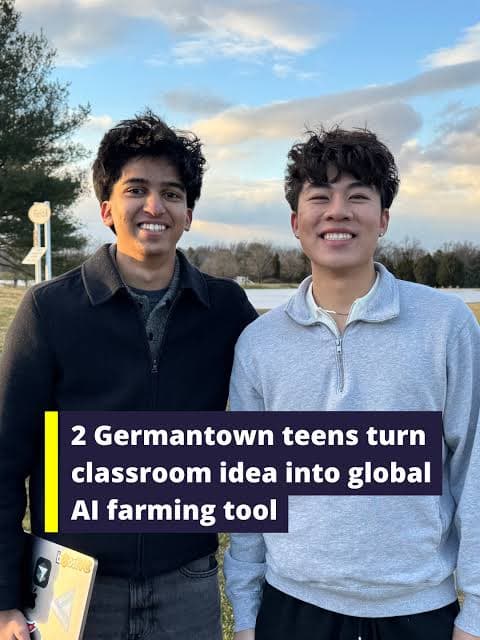
Evion
Co-founder. July 2025 to January 2026.
Evion was an AgTech startup I co-founded to give back to the rural community of Poolesville, where I went to high school. We trained a UNet/pix2pix model to predict crop health from plain RGB drone imagery, so farmers could get multispectral-grade insight without multispectral-grade hardware costs.
Building Evion was one of the most fun I've ever had. We iterated through many versions and approaches, most notably sneaking into our school computer lab to build our own custom data scraping network until we got caught and had to abandon that strategy. We ended up using a public dataset from UIUC.
By the end we had reached 2,000+ farms across four continents. And the best part of working on it is hearing the stories from farmers who's family farms were saved from economic struggle using our product.
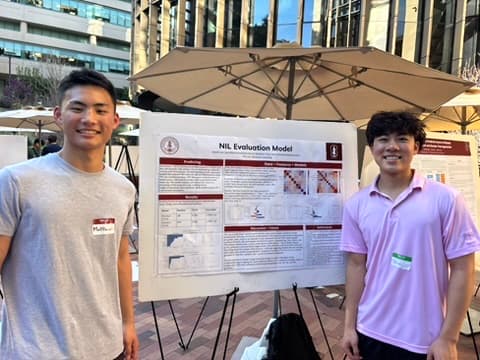
Stanford Multi-Robot Systems Lab
ML research. March 2026 to present.
I implemented a next-best-view (NBV) planner for embodied 3D scene exploration. The core algorithm solves a Second-Order Cone Program (SOCP) to find the next camera pose that maximizes coverage of tracked 3D surface points. The system maintains a geometric memory of correspondences, each with a 3D position, surface normal, and history of viewing directions, and uses this information to identify under-observed regions of the scene.
The planner operates in two nested loops: an outer search over candidate optical axes sampled on the unit sphere (using Fibonacci sphere sampling with adaptive refinement), and an inner SOCP that finds the optimal camera origin for each fixed axis. The coverage objective is formulated as a convex surrogate — the maximum inner product between a proposed viewing direction and past viewing directions — which captures how much new angular information a candidate view would provide. Visibility is modeled geometrically as a truncated cone, ensuring proposed views are physically valid.
The system is evaluated against two baselines — a random planner and NeU-NBV (a learned uncertainty-driven approach using a pretrained pixelNeRF model) — in simulation environments including Gaussian Splatting renderers and Habitat-Sim physics environments. Experiments on MipNeRF360 scenes (room, bonsai) and ReplicaCAD environments show that the SOCP planner achieves substantially higher directional spread and well-covered track fraction than both baselines, demonstrating that geometric coverage optimization without learned priors can outperform neural approaches in structured exploration settings.
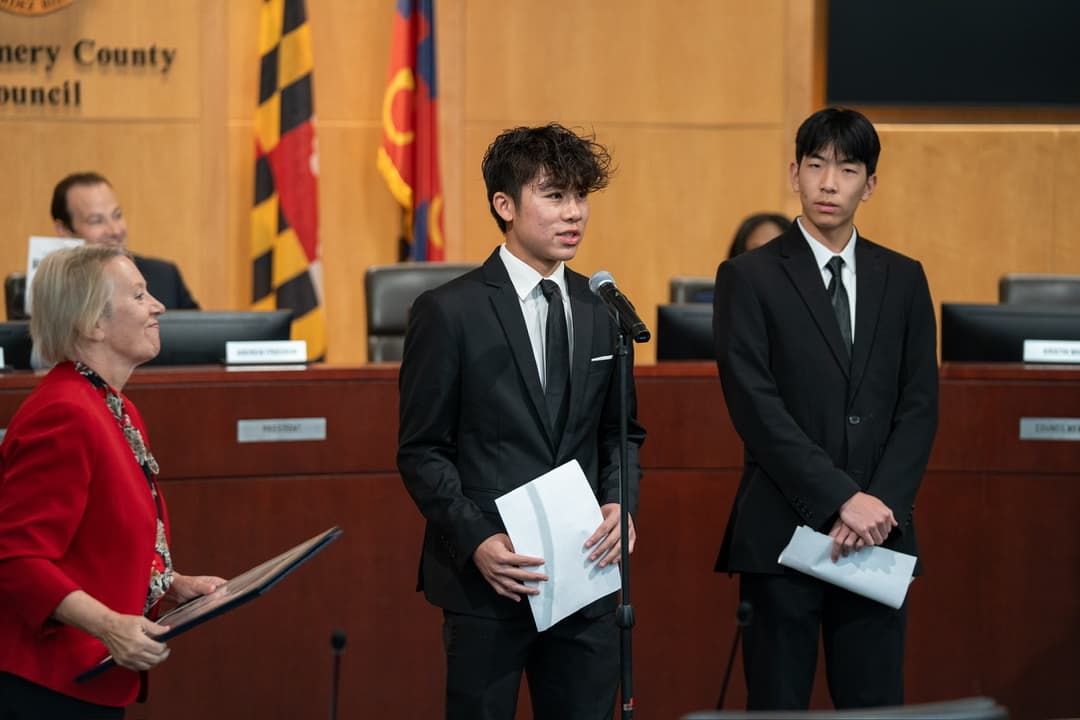
Runway
Founder. January 2024 to May 2025.
Runway was a nonprofit mobile app I built in my senior year of high school to help middle school students discover STEM. The format was short-form and gamified, similar to TikTok and Instagram, but the reels were replaced with bite-sized STEM lessons. A global leaderboard ranked users by lessons completed and accuracy, which turned out to be the hook that kept kids coming back.
We reached 1,000 daily active users, integrated it with Montgomery County Public Schools, and received a proclamation from the Montgomery County Council for the app's impact on STEM education in the county.
uSole
Founder. October 2023 to May 2024.
In my junior year of high school I developed a replaceable, biodegradable shoe outsole for basketball shoes. The material was derived from an algae-based TPU that increased traction while costing a fraction of a new pair of shoes. The idea was simple: basketball players burn through outsoles fast, and buying new shoes every few months is expensive and wasteful.
I paired the outsole with a waterproof adhesive I developed to attach it to the shoe, and filed a provisional patent on the system. The outsole saved users money and kept worn-out shoes out of landfills.